
The Acquisition That Split the Room
Late 2024 landed like a grenade in the art world. MoMA announced it would formally acquire AI-assisted works into its permanent collection, and the reaction wasn’t polite disagreement. It was a full ideological schism. Artists stormed social media. Critics penned furious manifestos. Traditionalists declared the death of craft. What looked like a simple curatorial decision was actually an institution-sized confession: we no longer believe we can hold this line.
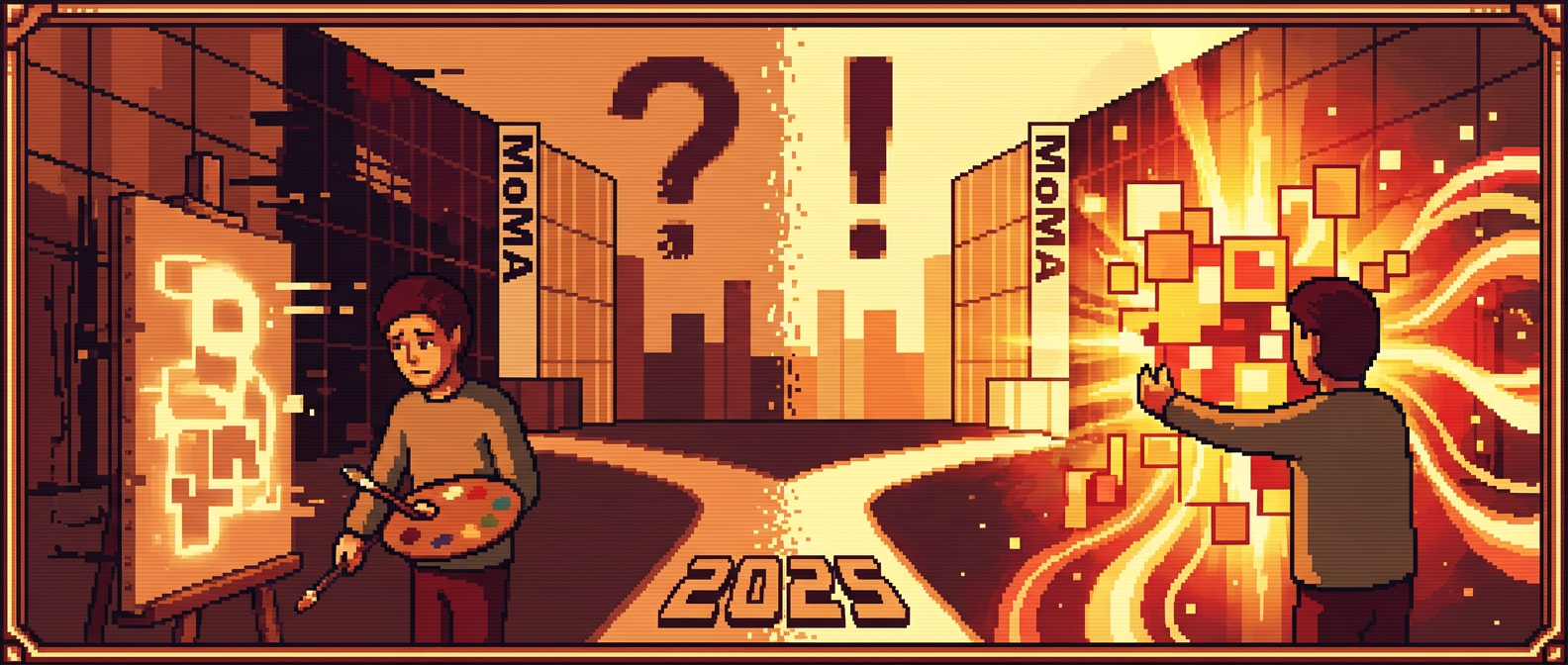
This wasn’t some rogue curator going rogue. This was the Museum of Modern Art, the institution that legitimized Pollock and canonized Warhol, deciding that the future of art includes algorithmic generation. The decision didn’t happen in a vacuum, though. It happened after Refik Anadol’s ‘Unsupervised’ installation pulled over 400,000 visitors through MoMA’s doors in 2023. That kind of foot traffic changes institutional calculus. Museums aren’t charities. They’re not gatekeepers anymore, if they ever really were. They’re repositories trying to stay relevant.

The Money Tells a Story Markets Can’t Hide
Follow the money and you find the real story. AI-generated art sales hit $1.3 billion globally in 2024, up from roughly $200 million in 2022. That’s a 240% climb in two years. Not incremental growth. Explosive growth. Meanwhile, Christie’s launched a dedicated ‘AI & New Media’ auction category in March 2025, and their first evening sale generated $8.2 million. Single evening. Eight point two million dollars. These numbers aren’t fringe activity. They’re market force.
The institutional response follows predictable economics. Institutions collect what matters. They collect what endures. And they collect what sells because that’s how they fund everything else. MoMA’s decision isn’t a betrayal of artistic values, then. It’s a naked acknowledgment that the market has moved and they need to move with it or become a museum for yesterday’s artists instead of tomorrow’s.
Why 61% of Studio Artists Feel the Ground Shift
A 2025 survey from the College Art Association resources on AI and art ethics found that 61% of working studio artists believe AI art acquiring museum status undermines the labor and craft of human artmaking. That’s not a minority position. That’s a majority hurt. And the hurt is specific. It’s not abstract anxiety. It’s about process.
Here’s what working artists actually do: they spend years developing technique. They fail repeatedly. They study materials. They learn how canvas behaves under different pressures, how pigment interacts with medium, how the physical world resists and cooperates with their intentions. They build a visual language through accumulated decision-making across thousands of hours. Then an algorithm generates 500 variations of a concept in minutes and someone calls it art. The confusion is understandable. So is the rage.
But here’s where the conversation gets interesting instead of predictable. The question isn’t whether AI-generated imagery is “real art.” That’s boring. The question is what happens to the concept of craft when institutions stop privileging it. Because craft has never been art’s only value. Conceptual art mostly evacuated craft concerns decades ago. Duchamp was never precious about his hands. The real issue is labor recognition and economic viability.
The Institutional Pivot and What It Actually Means
MoMA’s shift represents something larger than one museum’s acquisition policy. It represents an institution deciding that curation matters more than gatekeeping. Look at MoMA’s collection and acquisition philosophy and you’ll see language about documenting artistic practice across media and technology. That language existed before AI. It just never had to reckon with something that could produce convincing imagery without intention, without lived experience, without any of the biographical weight that collectors and curators have traditionally valued.
The bold part of MoMA’s move isn’t the acquisition itself. It’s the admission that they don’t fully understand what they’re collecting yet. They’re collecting a process they can’t entirely evaluate, collecting the present moment rather than waiting for historical distance. That’s either courageous or reckless, depending on whether this matters in fifty years or becomes a footnote.
What doesn’t get said often enough: this decision also opens space for legitimate evaluation. If AI art enters the museum’s permanent collection, it becomes subject to the same scrutiny, reconsideration, and periodic dismissal as everything else. Some of it will endure. Most won’t. That’s how institutions actually work. They acquire aggressively and the rest becomes the culling floor.
The Real Question Nobody’s Asking
The betrayal narrative assumes MoMA had a responsibility to protect traditional artmaking. They don’t. Museums have a responsibility to document what culture is doing, not to preserve what culture used to do. The harder question is whether AI-generated work actually requires the same kind of aesthetic judgment that human-made work demands. If it doesn’t, then institutions incorporating it into permanent collections might be committing a category error. Not a betrayal. A confusion.
That’s worth arguing about at the dinner table. That’s worth demanding clarity on from curators. How do you evaluate something designed to be iterative and mass-produced through the same lens you use for something made once, in singular intention? Those aren’t the same problems. But they’re both problems worth solving before the acquisition policy gets locked in.
