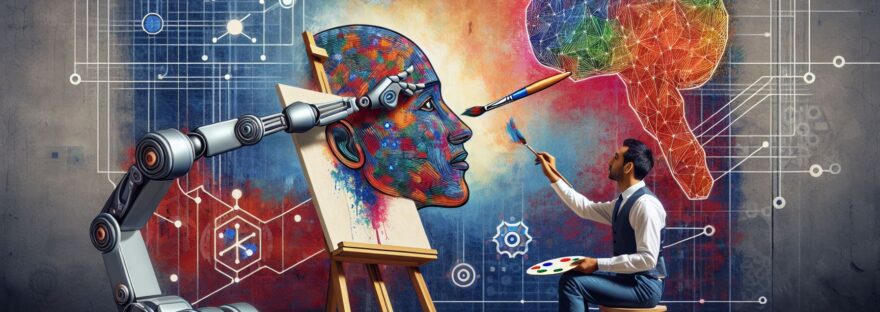
AI’s impact on creative expression has been on my mind a lot lately. Sure, we hear plenty about AI streamlining business operations and automating mundane tasks, but what really gets me excited is how it’s changing the way we make art. There’s something fascinating about watching technology and human imagination work together to create things we’ve never seen before.
The Rise of AI in Creative Arts
AI has moved way beyond just copying what humans do creatively. It’s actually making the creative process faster, more precise, and frankly, more accessible than ever. I’ve watched friends with zero artistic training use AI tools to create digital art that would’ve taken years to learn through traditional methods. It’s not replacing human creativity so much as giving it new superpowers.
Redefining Art with Algorithms
The tech behind AI art centers on machine learning algorithms that can spot patterns in massive datasets, patterns that would take humans forever to identify. Generative adversarial networks (GANs) are particularly clever. They work by having two neural networks compete against each other, and the result is images so realistic they can fool art experts. It’s completely changing how we think about creating, viewing, and even buying art.
Remember “Edmond de Belamy”? That AI-generated portrait sold for over $400,000 at Christie’s. While people argued endlessly about whether a machine could truly create “art,” the sale proved that AI has already entered the high-end art world, whether purists like it or not.
Music’s New Maestros
AI’s work in music composition honestly blows my mind. Neural networks can analyze thousands of existing pieces and then generate completely original compositions across any genre you can think of. Companies like OpenAI have built tools like MuseNet that let people with zero musical training create complex symphonies.
Real composers are starting to collaborate with AI too. Imagine if we could use AI to complete Beethoven’s unfinished works, not by guessing what he might have done, but by training algorithms on his entire body of work. That’s not science fiction anymore. It’s happening now, and it shows how AI can extend human creativity rather than replace it.
Democratizing Creative Expression
What really excites me about AI in creativity is how it’s breaking down the old gatekeeping systems. You don’t need years of art school or expensive equipment to create something beautiful anymore.
AI for the Everyman
Platforms like RunwayML and DeepArt have made it possible for anyone to create professional-looking artwork in minutes. Want to turn your vacation photos into something that looks like Van Gogh painted it? There’s an app for that. The learning curve that used to take decades can now be shortened to an afternoon of experimentation.
Writing tools powered by AI, like OpenAI’s GPT models, are doing the same thing for storytelling. They understand context and style well enough to help struggling writers find their voice or overcome writer’s block. I’ve seen people use these tools to write everything from poetry to screenplays, often producing work that surprises even them.
Patterns and Predictions
AI doesn’t just help create art, it can also predict what kinds of art will resonate with audiences. By analyzing cultural trends and consumer behavior, AI tools can give creators insights that help them make smarter creative decisions. It’s like having a crystal ball for artistic success, though obviously nothing’s guaranteed in the creative world.
Navigating Ethical Landscapes
Of course, all this innovation comes with some thorny questions that we’re still figuring out.
Who Owns the Art?
When an AI creates a piece of art, who gets the credit? The programmer who built the algorithm? The AI itself? The person who provided the training data? These aren’t just academic questions anymore, they’re showing up in real legal cases. The art world is still wrestling with these questions, and honestly, I don’t think we have good answers yet.
Authenticity Amid Automation
There’s also the question of whether AI-generated art has the same cultural value as human-created art. Traditional art has always been about expressing human experience and emotion. Can a machine do that authentically? Art purists say no, but I’m not so sure the distinction matters as much as we think it does. If a piece moves you, does it matter who or what created it?
These philosophical debates are reshaping how we think about creativity, ownership, and what art even means in the first place.
Conclusion: Embracing a New Renaissance
AI is fundamentally changing how we approach creativity, and I think we’re just scratching the surface. This feels like the beginning of a new renaissance where human imagination gets amplified by machine capability in ways we never thought possible.
For artists and tech enthusiasts, this is an incredible time to be alive. Creative ideas that used to be impossible to execute are now within reach for anyone willing to experiment. AI has become more than a tool, it’s become a creative partner that can push us toward ideas we never would have reached on our own.
We still need to work through the ethical questions around ownership, authenticity, and what creativity even means anymore. But the potential here is enormous. AI and human artistry together are opening up creative possibilities that neither could achieve alone.
So are we ready for this new era of AI-enhanced creativity? The tools are here, the possibilities are endless, and honestly, I can’t wait to see what we come up with next.
