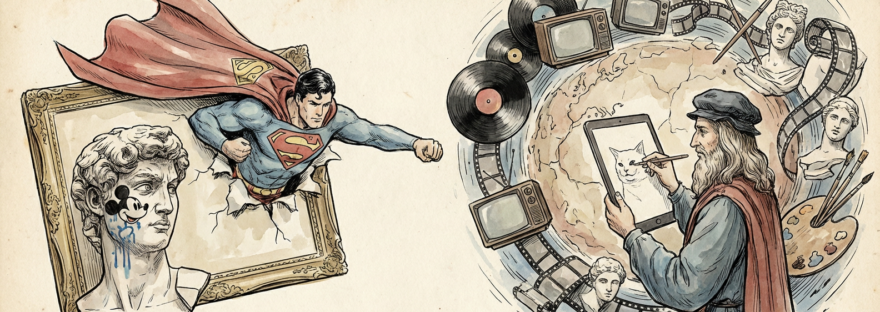
The Collision Course: When Pop Metrics Invade the Artist’s Workshop
Walk into any contemporary art studio today and you’ll find something that would have baffled Jackson Pollock: artists checking their Instagram analytics between brushstrokes. The sacred space of creation has become a laboratory for virality testing. This isn’t just about marketing finished pieces anymore. Pop culture’s algorithmic logic has infiltrated the actual making process, changing how artists conceive, develop, and execute their work.

Consider Kerry James Marshall’s recent shift toward incorporating social media aesthetics into his painting technique. His “Untitled (Studio)” series doesn’t just reference digital culture, it adopts the visual grammar of smartphone photography directly onto canvas. The compressed color palettes. The flattened perspective. The deliberate artificiality of ring lighting effects rendered in oil paint. Marshall isn’t pandering to Instagram. He’s questioning how digital mediation has rewired our visual cortex, then translating that rewiring back into traditional media.
This is a complete reversal of the historical relationship between high and low culture. Previously, pop culture absorbed and simplified fine art innovations. Think of how Mondrian’s geometric abstractions eventually showed up on coffee mugs. Now the flow runs backward. Artists mine TikTok’s 15-second attention economy for formal strategies, then deploy those strategies in works that demand hours of contemplation.

Speed as Medium: The Accelerated Craft Revolution
The most radical transformation isn’t happening in galleries. It’s happening in time itself. Pop culture operates on release cycles measured in weeks, not the decades traditionally required for artistic maturation. This temporal compression has forced fine artists to develop new working methods that can accommodate both depth and velocity.
Look at how painter Shara Hughes approaches her landscape abstractions. She’s developed a technique that lets her complete complex, multi-layered canvases in single sessions lasting 12-16 hours. This isn’t about rushing. It’s about designing a process that can capture the temporal rhythm of contemporary experience. Her paint application mimics the gestural fluidity of digital drawing apps, but scaled up to gallery proportions and executed in materials that will outlast any server.
Hughes layers transparent glazes between periods of aggressive mark-making, creating depth through accumulation rather than the slow building traditional to oil painting. Each layer corresponds roughly to a social media scroll session. The result reads as both immediate and archaeological. You can see the artist thinking in real-time while creating something that rewards extended looking.
This acceleration has also spawned entirely new hybrid practices. Artist and programmer Casey Reas creates algorithmic drawings that exist simultaneously as code, screen-based animation, and large-scale prints. His process involves writing software that generates thousands of variations, then selecting specific moments for physical realization. The computer becomes both collaborator and printing press, allowing him to work at the speed of digital culture while producing objects that exist outside it.
Material Rebellion: When Physicality Pushes Back
The most fascinating development isn’t artists embracing digital methods. It’s how they’re weaponizing materiality against the dematerialized logic of pop culture. Sculptor Simone Leigh builds monumental ceramic works that demand physical presence in an age of virtual experience. But her process directly incorporates techniques borrowed from viral content creation.
Leigh documents each stage of her building process through photography, creating visual narratives that mirror the behind-the-scenes content that drives social media engagement. However, she uses this documentation to solve formal problems rather than generate followers. The photographs become compositional studies, revealing how her sculptures will read from different viewpoints and lighting conditions.
Her ceramic techniques themselves blend traditional West African pottery methods with contemporary industrial processes. She uses kilns that can reach temperatures previously impossible, allowing her to work at scales that compete with Instagram’s appetite for the spectacular. The works succeed precisely because they cannot be fully captured by cameras. They use pop culture’s own strategies against its flattening effect.
This material rebellion extends to artists working in traditionally ephemeral media. Tino Sehgal creates “constructed situations” that exist only in live encounters between visitors and performers. His pieces cannot be photographed, recorded, or documented. They spread through word-of-mouth, like pre-digital folklore. By refusing documentation, Sehgal forces his work to operate according to temporal logic that predates mass media entirely.
The Collaboration Paradox: Individual Vision in Collective Creation
Pop culture’s collaborative production models have infiltrated fine art studios in ways that challenge romantic notions of individual genius. Artists now work with teams of fabricators, digital specialists, and research assistants. But unlike commercial entertainment, these collaborations often intensify rather than dilute artistic vision.
Kaws built his practice by bridging the gap between designer toy culture and fine art. His process involves designing characters that work across multiple scales and media, from small vinyl figures to massive public sculptures. This requires collaboration with manufacturers, engineers, and installation specialists. But rather than compromising his vision, these collaborations allow him to think systematically about how images translate across different physical and cultural contexts.
His studio operates like a combination of traditional atelier and design consultancy. Each project involves extensive prototyping, testing different materials and production methods. The final works succeed because they’re designed from the beginning to operate within pop culture’s circulation systems while maintaining the conceptual density expected in gallery contexts.
Sculptor Anselm Kiefer represents the opposite approach to the same problem. His recent works incorporate found materials ranging from social media screenshots printed on canvas to literal fragments of bombed buildings. He treats pop culture as raw material, subjecting digital imagery to the same alchemical processes he applies to lead, ash, and concrete. The collaboration happens between the artist and the cultural moment itself.
Process as Resistance: Making Time in a Timeless Medium
The ultimate impact of pop culture on fine art may be its creation of a new form of resistance. Artists are developing processes that explicitly counteract digital culture’s erasure of duration and craft knowledge. Painter Amy Sillman spends years developing bodies of work that examine single emotional or conceptual territories. Her process involves constant overpainting, with each canvas accumulating dozens of previous compositions beneath its final surface.
This temporal layering creates works that operate as both paintings and archaeological sites. You can see the artist’s thinking evolving across time, each decision preserved as a physical trace within the final object. The paintings become arguments for the value of sustained attention in an economy that profits from its scarcity.
What emerges from these various approaches isn’t a rejection of pop culture, but a sophisticated negotiation with its terms. Artists are learning to harness its energy while preserving the deeper temporalities that allow complex ideas to develop. They’re creating works that can circulate within contemporary attention economies while rewarding the kind of sustained engagement that those economies actively discourage.
The real question isn’t whether pop culture will continue shaping fine art. It’s whether fine art can maintain practices of making that offer genuine alternatives to pop culture’s dominant rhythms. These artists suggest it can, but only through processes that are as rigorous and inventive as the forces they’re responding to.
