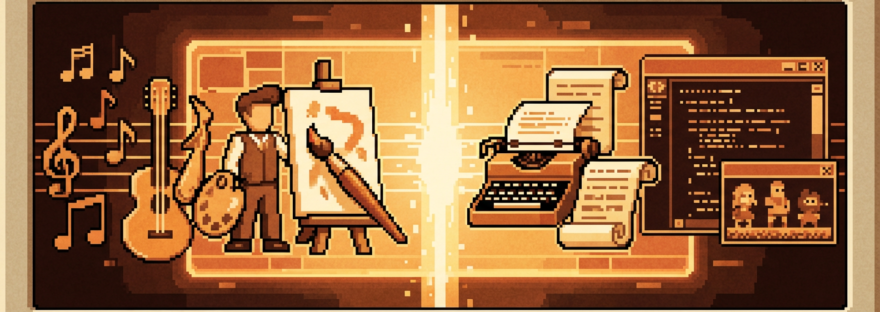
The Seductive Lie of Interdisciplinary Genius
Every month, another gallery announces its latest multimedia installation. A painter collaborates with a composer. A filmmaker teams up with a choreographer. The press releases practically vibrate with self-importance, promising transcendent experiences that blur the boundaries between artistic forms. What we usually get instead is a confused mess where neither medium does what it does best.

The problem isn’t collaboration itself. The problem is that most artists approach cross-medium work like tourists in each other’s countries, speaking loudly and slowly while missing the entire point. When Laurie Anderson created “United States Live” in the early 1980s, she wasn’t just adding music to spoken word or visuals to sound. She was creating a new language that could only exist in the intersection. Most contemporary attempts feel like elaborate PowerPoint presentations with pretensions.
True interdisciplinary work requires each artist to give up something fundamental about their practice. It demands genuine vulnerability, not just the sharing of studio space and Instagram handles. The current trend of slapping different mediums together and calling it innovative collaboration is intellectual laziness dressed up in grant-friendly language.

When Ego Gets in the Way of Art
Watch any documentary about failed collaborative projects and you’ll see the same pattern. Artists who can’t shut up about their “vision” long enough to listen. The painter who insists the dancers must move according to the rhythm of their brushstrokes. The musician who treats the filmmaker like a glorified music video director. These aren’t collaborations, they’re hostile takeovers with multiple casualties.
Look at the disaster that was Robert Wilson and Philip Glass’s early attempts before “Einstein on the Beach.” Wilson, with his glacial theatrical pacing, and Glass, with his relentless minimalist cycles, should have been incompatible. Instead of forcing compromise, they found a third space where time itself became sculptural. The opera doesn’t feel like theater with music or music with staging. It feels like witnessing the birth of a new art form.
Compare that to the countless gallery shows where painters “collaborate” with sound artists by literally hanging paintings next to speakers. The visual work doesn’t inform the audio. The audio doesn’t transform how we see the paintings. They just coexist, like roommates who split the rent but never speak. This isn’t synthesis, it’s expensive interior decorating.
The Mythology of Pure Mediums
Part of the problem comes from a fundamental misunderstanding of what artistic mediums actually are. We’ve mythologized the idea that painting, sculpture, music, and dance exist in pristine isolation. This is historical nonsense. Medieval manuscripts were multimedia projects. Renaissance frescoes were immersive environments that combined architecture, painting, and often music during their viewing. The separation of artistic disciplines is a relatively recent academic invention.
Even photography, which we treat as a distinct medium, began as painting’s bastard child and evolved by stealing techniques from printmaking, theater, and literature. Cindy Sherman’s “Untitled Film Stills” work because she understands that photography was always already collaborative with performance, costume design, and narrative construction. She doesn’t add these elements, she reveals them.
The most successful cross-medium projects acknowledge this historical reality. They don’t try to bridge separate worlds, they dig up the connections that were always there. When Maya Deren collaborated with Marcel Duchamp and John Cage on “At Land,” she wasn’t creating an unprecedented hybrid. She was making visible the surrealist undercurrents that already flowed through experimental film, conceptual art, and chance-based composition.
The Economics of Authentic Collaboration
Money ruins everything, but it especially ruins artistic collaboration. Grant committees love interdisciplinary projects because they sound innovative and inclusive. Galleries love them because they can charge higher prices for “unique” experiences. Artists love them because they can split costs and share audiences. Everyone wins except the art itself.
Real collaboration takes time. Obscene amounts of time. Anderson and Cronenberg spent two years developing “Delusion Angel” before they even started filming. They had to learn each other’s languages, discover shared obsessions, and figure out what they could create together that neither could make alone. Most contemporary collaborative projects operate on quarterly timelines dictated by exhibition schedules and funding cycles.
The result is art that looks collaborative but functions as a series of compromises. The painter reduces their palette to accommodate the lighting requirements. The composer simplifies their arrangements to match the gallery’s sound system limitations. The choreographer choreographs around the sculptures instead of with them. Everyone adjusts their practice downward to meet in a pleasant middle ground that challenges no one.
True collaboration requires artists willing to risk failure, institutions willing to wait for results, and audiences willing to encounter something genuinely unfamiliar. These conditions are becoming increasingly rare in a cultural economy that demands immediate, quantifiable returns on creative investment.
Finding the Friction Points
The most exciting collaborative work happens when artists deliberately seek out incompatibilities. When Merce Cunningham worked with John Cage, they specifically avoided coordinating their efforts. The dance and music coexisted in the same time and space but followed independent logics. The friction between these parallel systems created a third experience that belonged fully to neither dance nor music.
This approach requires confidence that borders on arrogance. Each artist must trust their own practice enough to let it collide with someone else’s without trying to control the outcome. It’s the difference between a conversation and a lecture. Most collaborative projects feel like two people giving simultaneous lectures in the same room.
The best cross-medium work I’ve encountered recently was an unmarked collaboration between a sound artist and a perfumer in a Detroit warehouse. Visitors couldn’t tell where one artist’s work ended and the other’s began. The scents seemed to have rhythm. The sounds seemed to have molecular weight. It wasn’t documented, wasn’t funded, and lasted exactly one weekend. It was also more genuinely innovative than most museum exhibitions I’ve seen this year.
Maybe that’s the point. Real collaboration can’t be institutionalized or optimized. It emerges from genuine curiosity about what happens when different ways of thinking rub against each other until sparks fly. The sparks can’t be planned, purchased, or predicted. They just have to be trusted. What collaborations have you encountered that actually changed how you think about what art can do?
